白莲花
New Zealand Proposes Stricter Laws On Public Defecation_我的网站

一 |
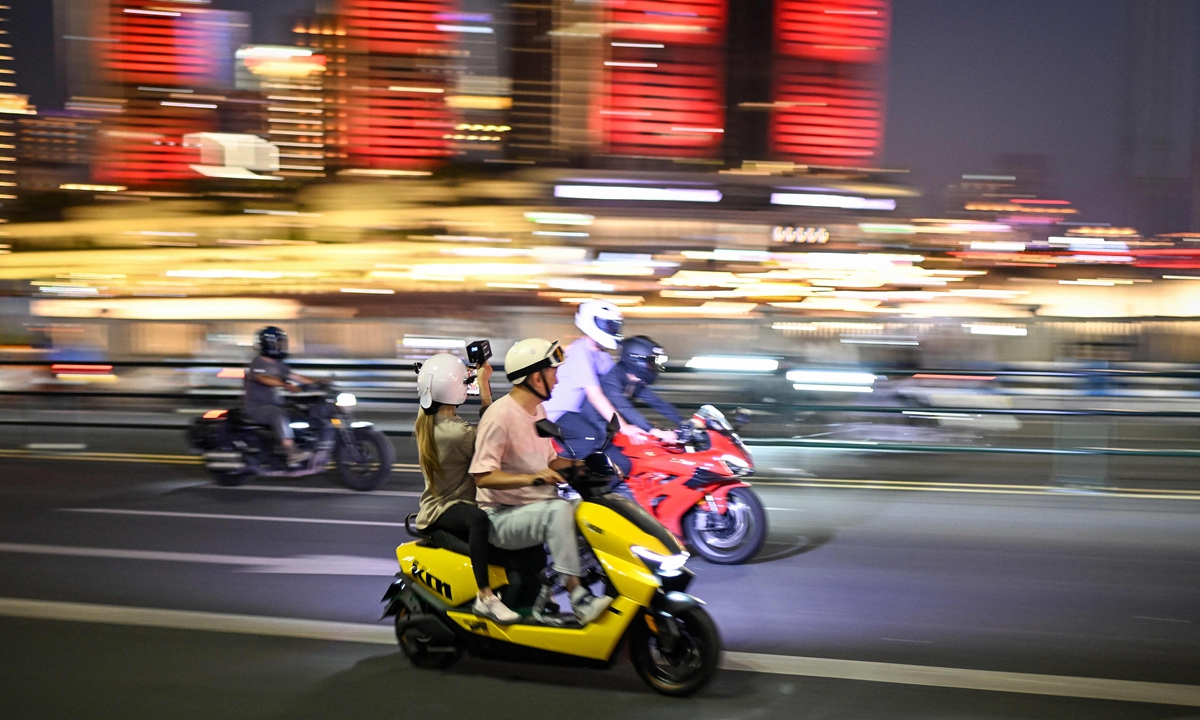
As night falls over Southwest China's Chongqing Municipality, motorcycles begin to weave along Nanbin Road, with riders posing against the glittering skyline across the Yangtze River. Within seconds, the moving camera captures bridges, high-rises and riverside lights - creating a signature travel moment that has become known online as the "Chongqing Landing Visa."
The trend has now spread beyond Chinese social media. On Monday, French rider Valentin Debise, who competes in the World Supersport Championship on a Chinese-brand ZXMOTO, posted a video thanking Zhang Xue for taking him to experience the "Chongqing Landing Visa."
The "Chongqing Landing Visa" is not an actual visa, but a humorous nickname coined by netizens for a popular motorcycle photo-op in Chongqing. Visitors ride or pose with motorcycles at designated spots along Nanbin Road, using Chongqing's dazzling nighttime skyline as a backdrop, while performing a series of signature poses, such as stretching out their arms, making a heart gesture or being lifted into the air, to capture their own video of the mountain city.
The motorcycle photo-op, a playful trend created by Chinese netizens, has rapidly gained popularity this year, with related videos garnering more than 1.52 billion views. An increasing number of celebrities, influencers and foreign tourists have joined in.
"People like the 'Landing Visa' not simply because motorcycles are cool, but because it combines some of the most distinctive elements of Chongqing into a single frame - the mountains, the river, the night skyline and the city's sense of speed," Chongqing-based motorcycle blogger Yu Tiancheng told the Global Times. "Visitors don't need to understand any complicated cultural background. They just get on a motorcycle, set off, and can start enjoying the city within seconds."
"For first-time visitors to Chongqing, motorcycles offer a very direct way in," Yu noted. "You're not just standing there looking at Chongqing. You're actually riding into its nighttime scenery."
The appeal of the "Chongqing Landing Visa" is not limited to professional riders or social media influencers. Young travelers from overseas are also discovering Chongqing through its everyday urban life.
A lively city
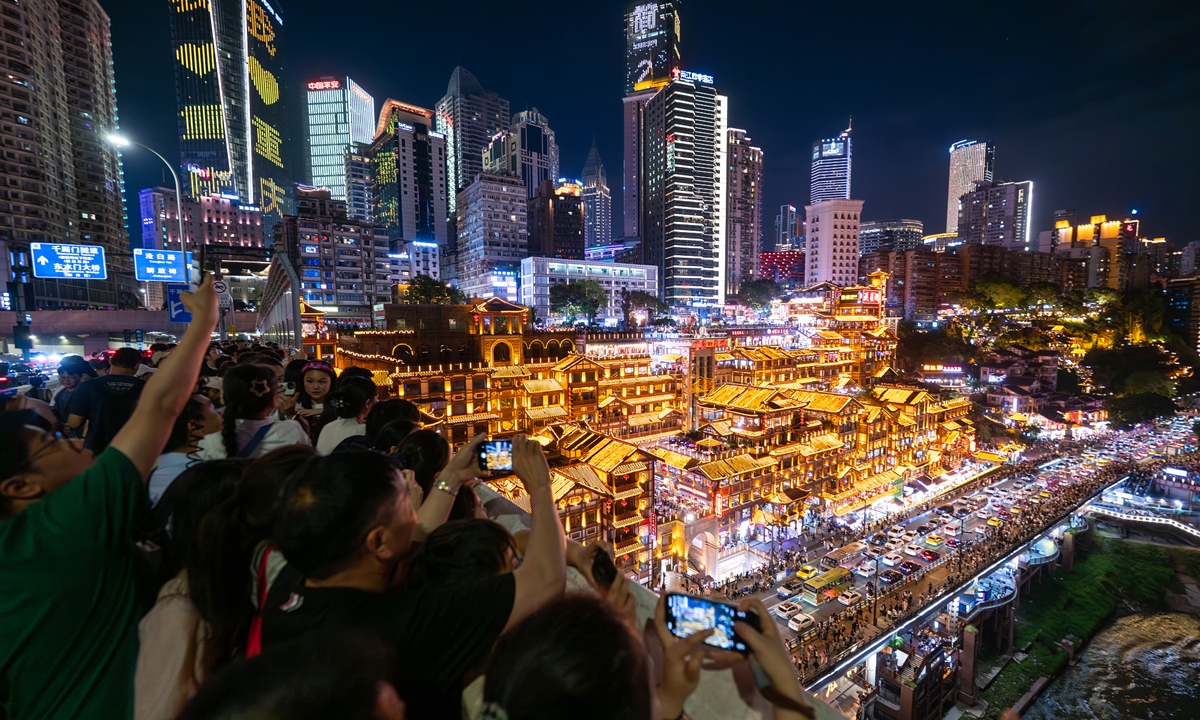
Kim Yeon, a graduate student from South Korea, visited Chongqing during her summer vacation in August. She told the Global Times that she had watched numerous "cyberpunk" videos of Chongqing on social media before her trip, but what surprised her most after arriving was the city's vibrant nightlife.
"Even late at night, there are still so many people on the streets, and restaurants, shops and small street-side businesses remain lively. For young travelers, that atmosphere itself is part of the travel experience," she said.
She was particularly struck by how Chongqing's nightlife is woven into everyday life rather than concentrated around a single tourist attraction. "You can have something to eat at night, walk around, go to the riverside to see the night view. A lot of activities can continue well into the night," she said.
This nighttime energy also provides a natural setting for the "Chongqing Landing Visa."
After spending the day exploring the city, visitors can continue discovering Chongqing after dark through motorcycle rides, nighttime tours and street-level experiences.
The motorcycle photo-op is therefore more than a photo opportunity; it has become part of the way young travelers experience the city at night.
That helps explain why Chongqing is attracting more young visitors from overseas. In the first half of this year, Chongqing Jiangbei International Airport handled more than 1.48 million inbound and outbound passengers at its immigration checkpoint, up 39.5 percent year-on-year, the fastest growth among China's 10 largest airports, according to Chongqing municipal people's government.
Nearly 70,000 foreign travelers entered Chongqing in July alone, up 84.7 percent year-on-year, according to Chongqing city government.
More than a destination
As more overseas visitors come to see Chongqing as a city they can enjoy and experience well into the night, motorcycles, night views and street life are becoming more than just backdrops - they are becoming experiences that travelers actively take part in.
Yang Gen, from the Chongqing Municipal Development and Reform Commission, told the Global Times that Chongqing's unique landscape and urban development have created a naturally three-dimensional cityscape. "Many places here are themselves scenes that people can experience and capture on camera," he said.
In his view, what makes the "Chongqing Landing Visa" interesting is that it was not a tourism project designed by the city in advance. Instead, visitors discovered a location and created a new way to experience it themselves.
"After people filmed and shared their experiences, more visitors were drawn to the same places, creating a natural chain of communication and influence," Yang said.
"This kind of approach, in which visitors participate in creating content and then attract more visitors through that content, is something traditional tourism promotion can hardly fully replicate," he noted.
Behind this new form of communication is also a shift in the travel preferences of younger tourists.
According to Yang, the ability to participate, experience and create personal memories is becoming an increasingly important factor when young travelers choose destinations.
The rise of the "Chongqing Landing Visa" also shows how locally created travel experiences can spread beyond borders through social media. As more international visitors share their China travel experiences online, China is attracting growing attention overseas.
Tesla CEO Elon Musk recently posted on X that "more people should visit China," while his mother Maye Musk has repeatedly shared her positive experiences of traveling in China.
The story of Chongqing offers a glimpse into this growing interest. The motorcycle trend is more than a viral moment; it shows how Chinese cities are attracting visitors not only through landmarks, but also through unique everyday experiences.
。

二 | New Zealand is perfectly fine with you pooping and peeing in public, as long as you make sure you aren’t being watched. But more restrictions on doing your business outdoors may be coming to the island nation soon.,Freedom Camping is camping on public land without paying a fee and is an activity quickly growing in popularity in New Zealand. In 2019, the year before the country shut down tourism due to the COVID-19 pandemic, more than 245,000 freedom campers enjoyed New Zealand’s famous landscapes while “freedom camping.” Of those, only 91,000 were Kiwis, indicating freedom camping is becoming a major tourist attraction for the small country.,However, it is also causing problems, something the Responsible Campers Association (RCA) wants to fix by adding more regulations on where freedom campers do their personal business and what they do with it after they are done.,'Crappiest Fountain Ever': UK Envoy's Husband Slashes Controversial New Zealand Landmark30 May, 10:23 GMT,The association wants new rules mandating that excrement must be buried at least 15cm (5.9 inches) and must be done at least 15 meters (49.2 feet) away from the nearest waterway.,The plea comes after multiple localities banned freedom campers from popular destinations because of a perceived increase in human waste and toilet paper being left at sites around the country. The issue became so heated that New Zealand’s tourism minister Stuart Nash told Radio New Zealand that freedom campers “pull over to the side of the road and … s*** in our waterways.”,The spokesperson for the RCA, Bob Osborne, says that blaming freedom campers is unfair. “There is no evidence linking any specific group to this undesirable practice which affects travelers all over New Zealand,” he said.,While the RCA advocates for a more permanent solution of more public restrooms, Osborne says that in the meantime, mitigation of the worst side effects of public defecation can be a solution, namely burying excrement and toilet paper and keeping it out of water sources. The association also stresses that campers should not be punished for the actions of a few bad apples, and that bad behavior should be punished, not camping itself.,Technically, public defecation is an offense in New Zealand that can result in a $200 fine, but that fine will be waived if the offender can show they had reason to believe no one could see them doing their business. Nash will be introducing new regulations to parliament later this year, including harsher fines for bad behavior and restrictions on where freedom campers can park.,With COVID-19 restrictions on tourism being lifted in the country, 2022 is expected to be a big year for freedom camping in New Zealand. With unburied defecation still allowed under law, campers are advised to watch where they step.。

三 |
Current article:http://8tr3bu.tandianxiuzhutiaoshoudiamei.pics/news/20260826_3867.html
Published on:18:17:06
 豪杰春香
豪杰春香 舞出我人生
舞出我人生 调解面对面
调解面对面 请回答1988
 伪娘
伪娘 同桌的你
同桌的你 一拳超人
一拳超人 小鱼儿与花无缺


